Hello, my name is Taro.
In the last issue, I explained the principle of PLL frequency divider/multiplier.
Using the principle of PLL frequency division/multiplication, we can apply spread spectrum to a clock signal.
What is spread spectrum used for?
Spread spectrum in clocks is a means of eliminating EMI noise caused by clock signals.
EMI ( Electromagnetic Interference ) is the electromagnetic interference that a device or system causes to the outside world.
It has nothing to do with a certain record company. (laugh)
The clock signal changes the current flowing through the wiring, which inevitably emits EMI.
This EMI is regulated by the FCC (Federal Communications Commission).
Faraday shielding can be implemented as an EMI countermeasure, but it increases the package size of the device.
By applying spread spectrum to the clock signal, EMI can be reduced without implementing Faraday shielding.
How does spread spectrum reduce EMI?
Spread spectrum reduces EMI by intentionally modulating the frequency of the clock.
Without spread spectrum, it is as if all the energy is concentrated on a single frequency.
Spread spectrum widens the frequency band used and spreads the energy.
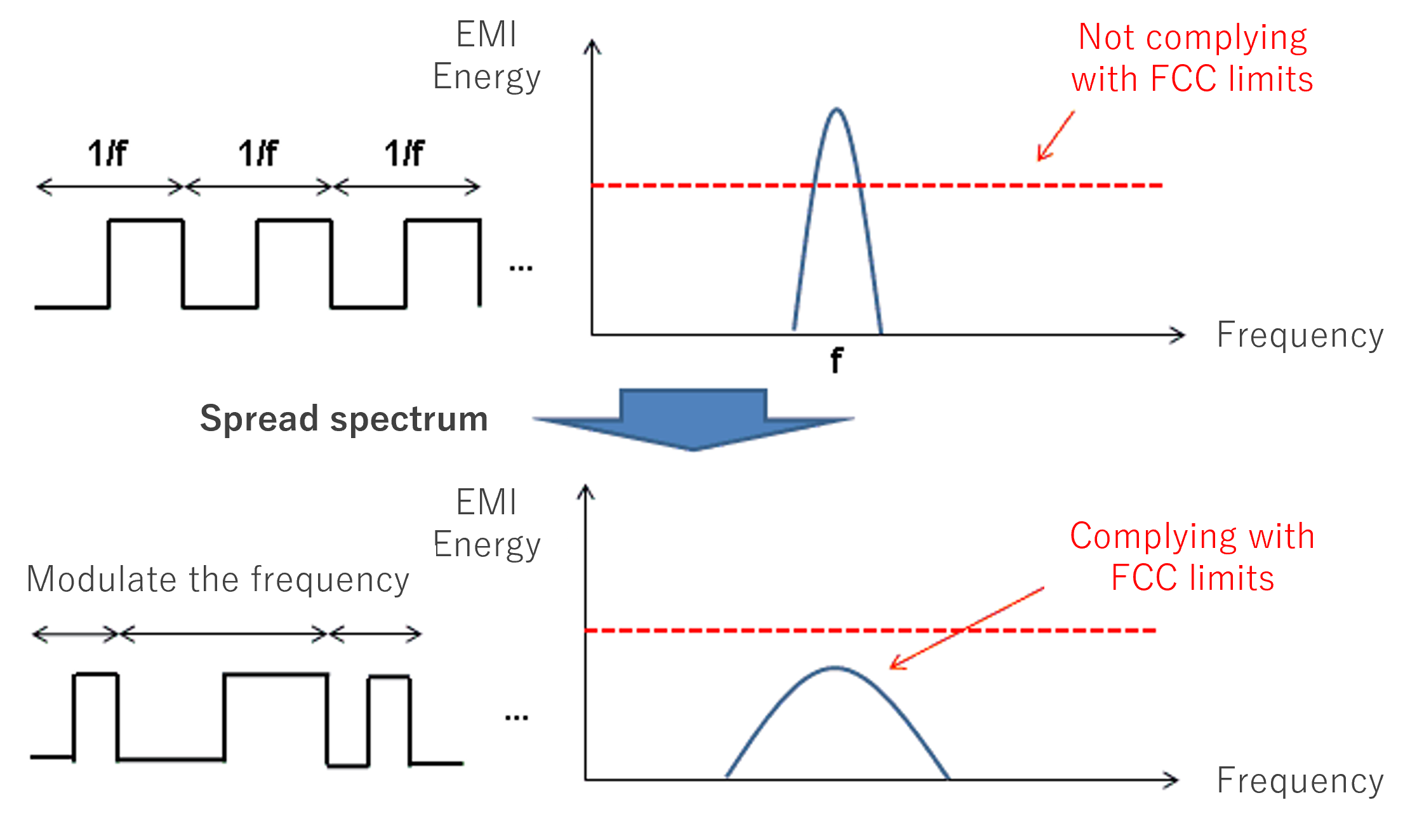
Principle of Spread Spectrum
Finally, this is where the PLL comes in.
As explained in the previous section, spread spectrum intentionally modulates frequencies, and PLLs are used for this modulation!
Spread spectrum is achieved by changing the division factor of the FB divider in the PLL.
There are two types of spread spectrum: center spread and down spread.
The center spread method spreads the frequency to be spread over a wide or low frequency range.
On the other hand, the down spread spreads frequencies only in the low frequency range.
These are used according to the guaranteed frequencies of the later stage devices.
Precautions when using spread spectrum
Spread spectrum is a great way to reduce the amount of EMI emitted, but there is a caveat.
When using spread spectrum clocks in a system, the clock generators must be unified.
As you may have wondered when looking at the clock waveform of the spread spectrum principle, there is timing jitter in the spread spectrum clock signal.
Spread spectrum can be said to be a technique that intentionally causes timing jitter.
Since the frequency is constantly changing, the clock generator must be unified in order to synchronize the entire system.
There is one more point that must be noted.
When spread-spectrum clocks are spread by a buffer, the loop bandwidth of the PLL must be set to a wide range.
I will write more about the complicated relationship between the PLL loop bandwidth and spread spectrum in the next article.
A New Engineer's Blush Blog Article List